Showing posts with label chinese. Show all posts

Sunday, 5 June 2022

Cream Crackers Pork Chop 苏打饼干猪排


I came to know about cream crackers coating through its use in Hainanese Chicken Chop. This chop is a perfect epitome of fusion Hainanese-Western food. I wanted to try out the cream crackers coating. I am using pork chop as I just happened to have some that I would like to marinade. You can also replace it with chicken chop. 

Wednesday, 21 July 2021

Home-style Gong Bao Chicken/ Kung Po Chicken 宫保鸡丁


Gong Bao Chicken is undoubtedly a popular Chinese dish. I had a hard time deciding which term to use for this recipe. In case you are wondering, Kung Po Chicken is the Cantonese dialect for this dish, while Gong Bao Chicken is the Mandarin pronunciation. Both are legit and refers to the same thing. Gong Bao is a style of cooking, not unlike your sweet sour chicken. You can use this style of cooking on other proteins too, such as prawns or even frog!

Friday, 20 November 2020

Wat tan hor 滑蛋河 Cantonese Fried Kuey Teow


First and foremost, let me do a little introduction on the term Wat Tan Hor. Wat Tan basically means smooth egg and Hor basically means kuey teow or flat rice noodle. It is a well-known dish in Malaysia and its neighbouring country, Singapore. 

Sunday, 18 October 2020

Nam Yue Pork Belly / Red Fermented Beancurd Pork Belly 南乳炸肉


This is my family's favourite for the longest time. Then again, anything crispy is my family's favourite.  It is fragrant, crispy and full of flavour. It is amazing what some little pieces of red fermented beancurd can uplift a normal dish so much.

Wednesday, 22 April 2020

Easy Recipe - Minced Meat Tofu 肉酱豆腐


Hi, again!

Today I will be introducing a Chinese Style Minced Meat Tofu. There are many variations to Minced Meat Tofu, some like to fry the tofu, some like to cut the tofu into small pieces and some like to use sliced Japanese tofu. In line with my easy recipe theme, I am using steamed whole tofu. No cutting, no frying. It is also my personal preference as I like soft tofu.

Friday, 10 April 2020

Easy Recipe - Chinese Stir-fry Pumpkin 炒南瓜


In view of the extended Movement Restriction order, I believe most of you have ran out of ideas of what to cook for your family. Hence, I would take this opportunity to introduce a series of easy-to-cook recipes that are both nutritious and delicious. Hope these recipes would be able to give you an idea in this trying time.

Friday, 24 January 2020

Salted Egg Yolk Cornflakes 咸蛋黄炒玉米片


It is Chinese New Year's eve already!!

I have to apologize for not updating more often. Pre Chinese New Year is always the busiest month. Today I finally get to literally breath. I told myself I have to update this lovely blog. I know it is almost Chinese New Year. Therefore, I am issuing an easy yet popular recipe.


Salted Egg Yolk Cornflakes has been the current Chinese New Year snack for several years now. Then again, anything salted egg yolk has been a popular option. I personally find this Salted Egg Yolk Cornflakes a little rich, but that does not stop my little bosses from devouring it like no tomorrow.

Cooking this is pretty simple and you just need a few ready ingredients. Do pay attention not to put your fire too high as the egg yolks burn easily.

Saturday, 7 September 2019

Pandan Huat Kuih 香兰发糕


Huat kuih
gets its name from its explosive top. The word huat in this context means expand, and kuih basically means our local traditional cake. Traditionally huat kuih is used by the Chinese as a prayer offering to deities or god. The more explosive it looks signifies the more prosperous and good fortune for the family.

Sunday, 11 August 2019

Beef sinew and daikon soup (presure cooker method) 清湯牛筋肉白萝


A brisket or tendon is normally paired with daikon instead of sinew. The sinew is actually a tough tissue in between the muscles. It is often sliced off and discarded when we cook the beef to prevent any chewiness. It is tough and chewy. However, with the right cooking method, it will turn springy and soft, with just the right resistance for a good chew, jut like a tendon would. I prefer to use sinew as it is often the cheapest as it is considered discards. This is just a way you can turn unused parts into something yummy.

Monday, 2 July 2018

Three Cup Chicken 三杯鸡


Today I tried the famous Taiwanese San Bei Ji which directly translates to Three Cup Chicken. What prompted me to try this Three Cup Chicken is the simplicity of the recipe. It was originally designed to use only three cups of ingredients comprising soy sauce, sesame oil, and rice wine. However, what the recipe doesn't tell you is that even in the three ingredients itself it has vast difference. For example, some soy sauce are darker and thicker whereas some are more salty. I would advise you to be careful with the soy sauce as we do not want the dish to be overly salty.

Saturday, 15 October 2016

Purple Sweet Potato Balls 炸紫薯球


I have been trying my best to update my blog these days. The opportunity comes when my mom actually had a disaster in the kitchen. Yes, she over-boiled her sweet potatoes making it too soft to be eaten or cooked. I was initially thinking of making sweet potato bread out of the pulp but she actually suggested something better. Potato balls...something that I haven't eaten for the longest time.


Normally, orange or white potato is used to make the balls. Purple sweet potatoes is considered better (and more expensive) as it is deemed to be more nutritious than its peers. Besides high in fiber, it has Vitamins A and C, Manganese and Anthocyanins (click here for more on purple sweet potato nutrients). I find the purple sweet potatoes to be the sweeter type and therefore I did not add as much sugar to it. If you are using the other types, do take this into consideration.

The making of sweet potato balls is relatively easy. Put some flour and knead it into a dough and then start pinching and rolling into smaller balls. Having said that, different places uses different flours for a variety of textures. In Thailand for example, plain flour and tapioca starch is used. In Malaysia, the Chinese like their balls a little chewy. Hence, the use of glutinous rice flour as part replacement. The more glutinous rice flour you put, the more chewy it would be. It is really up to your palate. I do not like my balls too chewy but remain fluffy and soft to the bite. Do play with your flour to get your desired texture. I added a little baking powder to make the ball puffed up as well. I like sweet potatoes balls best when it is still warm as the skin is crispy to the bite while the insides are soft and fluffy. A simple snack really, with basic ingredients and simple techniques but somehow it vows me everytime.

Fried Purple Sweet Potato Balls 炸紫薯球

Makes about 24 balls

Ingredients

300 g sweet potato, steamed and mashed
30 g glutinous rice flour (1/4 cup)
30 g cornstarch (1/4 cup)
2 tbsp sugar

Cooking Instruction


1. Mix all ingredients together to form a dough.


2. Pinch and roll with your palms to make a ball (approximately 15 g each).


3. Fry balls in pre-heated oil in medium heat, stirring constantly.

4. When balls starts to turn brown, remove from fire and strain. Best to serve hot.


Friday, 29 July 2016

Four Heavenly Kings (Stir-Fried Mixed Vegetables) 四大天王


It took me quite some time to find the name for this dish. This rather popular dish is no stranger in Malaysia. In fact, it is authentically Malaysian. As to why it was named Four Heavenly Kings, I believe it is the use of four types of vegetables usually brinjal, okra, long beans, and stink beans. The vegetables are interchangeable with others such as winged beans or snake beans. Plainly put, it is just stir-fried mixed vegetables. In true Malaysian style, this dish is usually served spicy with the use of chilli paste or sambal and dried shrimp. It has this unique pungent smell of the dried shrimp and the sting of the sambal. A truly flavour-filled dish indeed.

Friday, 3 June 2016

Black Pepper Beef 黑椒牛肉


What was meant to be a post on doughnuts became a typical Chinese stir-fried. Yes, I screwed up again. My doughnuts looked like biscuit, unworthy of mention. But all for the better because this black pepper beef is so good I ate a good portion of it.

Many Chinese dishes are stir-fried and mostly in high temperature to get it fragrant. The Chinese call this "wok hei" or breath of wok, very important in Chinese cooking. The high heat fittingly brings out that peppery fragrant with a slight sting to the tongue. Do be careful though as this dish is very "heaty" in nature. So make sure you drink a lot of water or herbal tea or you might just risk getting ulcer or falling sick (the Chinese believe that too much of the "yang" element would upset the balance in the body and hence, making you sick) .

Thursday, 5 May 2016

Steamed Egg with Ginger Juice 姜汁炖蛋


Many years ago, I had the opportunity to stay with my late grandmother in Ipoh. I remember vividly that she made me this humble egg custard dessert that I loved so much. As humble as it was, it was deemed a luxury to us back then. It was silky smooth. It was saporous sweet. And I was a hungry kid. There couldn't be a better match.

Now that I am all grown up, I realised what this dish is all about. Steamed egg with ginger juice is actually a very traditional Chinese dessert of the Cantonese clan. No wonder my grandmother had this dish up her sleeves.  She was Cantonese. This steamed egg with ginger juice is a pretty famous dessert in Hong Kong too. My grandmother's steamed egg with ginger juice, which I totally adore and vouch for, used whole eggs and ginger only, unlike other recipes whereby milk is also added. I only like it one way, that is how my grandmother made it. In case you are wondering what does it taste like, the custard tasted like Tong Kee's famous egg tart minus the tart shell.

Sunday, 17 April 2016

Yam Cake/Taro Cake 芋头糕


Taro cake or yam cake? Well, in this part of the world, it is called yam cake. Don't be deceived by the name. It is not a cake per se. This cake is savoury with lots of yam and other ingredients such as mushroom, dried shrimp and five-spice powder. I guess most of my Asian peers would have known that already. There is a slight difference between the Hong Kong version and our Southeast Asian version though. Ours is normally eaten steamed while the former is pan-fried after steaming. The Hong Kong version also have Chinese sausage and dried scallops added to the dish.

Thursday, 31 March 2016

Gua Bao with Braised Pork Belly 割包


Gua Bao is a humble Taiwanese street food that has its origins from Fuzhou. It comprises a U-shaped bun sandwiching a piece of luscious pork belly. Traditionally it is topped with pickled vegetables, crushed peanuts and a sprinkle of greens. It is really just another convenient snack in Taiwan that sees lesser light than its other more popular peers like Shilin Fried Chicken, Pineapple Tart or Taiwanese Sausage. On the other hand, it is rather popular in America when chef David Chang adopted it and gave it a new lift in his famed restaurant, Momofuku. The fascination of a "Chinese hamburger" really caught on.

Friday, 25 March 2016

Lotus Leaf Bun 荷叶包


It has been a while since I last posted a recipe on bao or Chinese bun. Recently, my interest was pique with this Taiwanese Gua Bao which is basically a U-shaped bao whereby you put your filling in the middle just like Western sandwiches. In fact, is was also known as the Chinese sandwich/hamburger. Well, let's not excite you further with this delicious Chinese hamburger today (don't worry, I promise I will comeback to this in coming posts). We are just going to talk about a bun that has that U-shape and functions to sandwich decadent pork bellies and other wonderful fillings - the Lotus Leaf Bun.

Friday, 18 March 2016

Stir-fried Beef with Ginger and Spring Onion 姜葱牛肉


I love this dish. Not so much of the ginger and spring onion per say, but I love the tender, springy beef slices. The ginger and spring onion compliment the dish well. It remove that beefy odour and at the same time, lend an aromatic sharp scent to the dish. It is really a match made in heaven. Best of all, this is a very easy dish. Everything happens in less than 5 minutes.

Having said that, it is essential not to overcook the beef or else it would become tough and chewy, spoiling the whole dish in the process. A very high heat is essential to bring out the flavour (the Chinese call it "wok hei"). The beef must not be cooked for too long in the wok. Therefore, do prepare everything beforehand. In order to make the beef more tender and springy, you could treat the beef with a little baking soda and then wash it off.

Thursday, 10 March 2016

Pork Belly with Taro (Yam) / Wu Tau Kau Yoke 芋頭扣肉


This comfort food has its origins from the Hakkas from China. It has that trademark upside-down presentation that is popular in Hakka dishes. By braising the dish in an upside-down manner for hours, the gravy and flavour are soaked completely by the meat and yam giving you that most scrumptious bite. It is no wonder why it is such a popular household dish.

Honestly speaking, this dish is not much of a looker. Any established chefs would have been appalled at its blackened mashed-up appearance. I would rather call this rustic. But once you have tasted these succulent layers of melt-in-your-mouth proteins, the mere uninspiring appearance would be enough make you salivating. I am not kidding.

Thursday, 25 February 2016

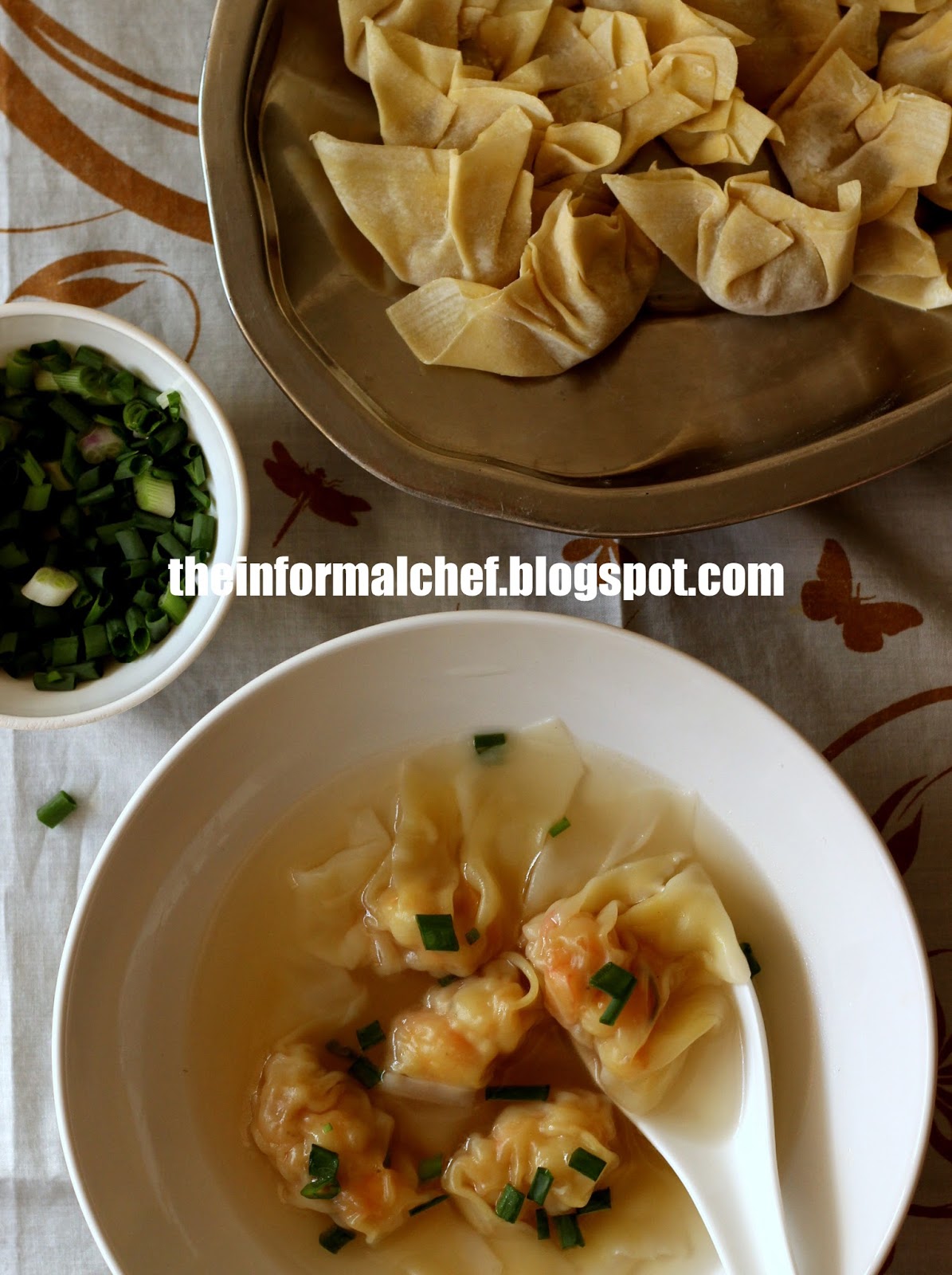
Crunchy Prawn Wonton Soup 虾云吞汤


Wonton is a smaller version of sui kow or dumplings, often with a thinner and and smaller skin. Just like its cousin, you can put almost any proteins to be wrapped in that silken skin. Prawn is a very popular ingredient for wonton. Unfortunately, we seldom find places selling good prawn wonton soup in Malaysia. I suspect fresh prawn is pretty costly, hence, making the business of selling prawn wonton soup unattractive.
Thank you for your dropping by to The Informal Chef. If you like what you have read and would like to SHARE this with your friends, kindly click on those little buttons available on top. I am also available in the following social medias:

FACEBOOK: www.facebook.com/theinformalchef
PINTEREST: https://www.pinterest.com/christineyong74/
BLOGGER: theinformalchef.blogspot.com

Add "like" in FACEBOOK, "follow" in PINTEREST, or add your email to my BLOGGER's e-mail or RSS feed to keep abreast with my latest postings.

Look forward to your comments. Cheers!